


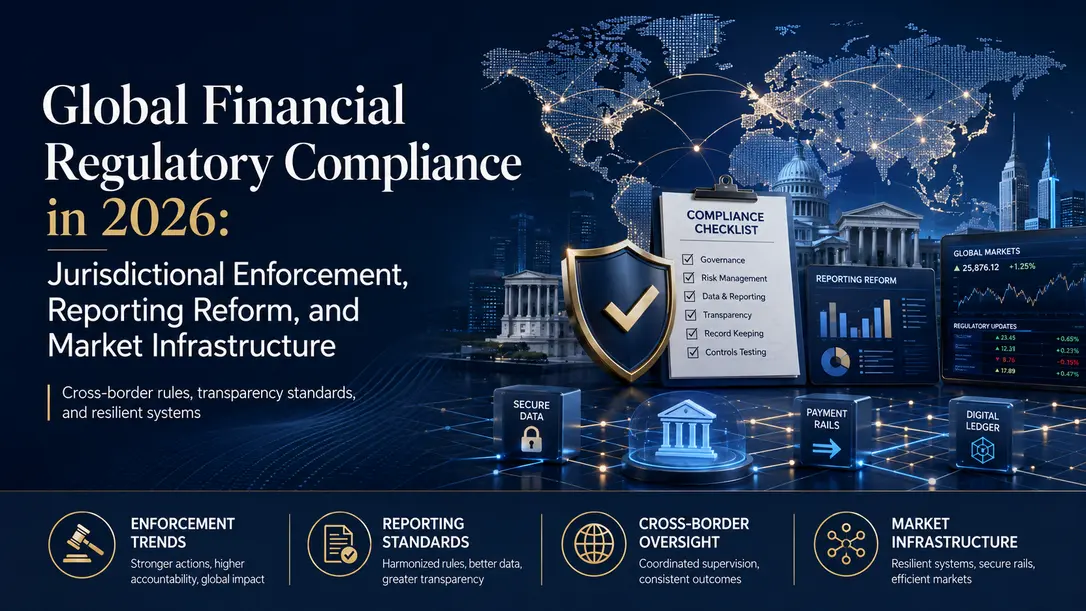
Operating a multinational enterprise requires managing contradictory regulatory mandates. While public commentary often speaks of standardizing cross-border compliance, national regulators pursue sharply distinct national priorities. A compliance framework built for the UK market cannot be copied into the US, just as European Union market structure initiatives operate on mechanics fundamentally different from those in Australia or Canada. Navigating financial regulatory compliance across these key markets requires an exact understanding of localized enforcement priorities, reporting reforms, and statutory requirements.
For corporate directors, chief compliance officers, and legal counsel, the primary challenge lies in separating jurisdictional realities from global generalizations. Regulators in major financial centers are modifying their oversight mechanisms at different speeds and with different goals. While one authority streamlines data collection to reduce compliance costs, another establishes targeted enforcement divisions to investigate financial misstatements, and a third mandates centralized market data infrastructure.
To establish an effective global compliance model, legal and risk leaders must carefully map their operational obligations to specific domestic oversight bodies. What works in one jurisdiction may leave a firm vulnerable to civil enforcement or operational friction in another. Cross-border organizations must evaluate how local statutory shifts impact their reporting pipelines, executive duties, and market access protocols.
Evaluating these international divergence patterns requires breaking down regulatory developments across five core jurisdictions:
- United States: Targeted enforcement initiatives focused on accounting fraud, financial reporting integrity, and executive oversight.
- United Kingdom: Transaction reporting reforms designed to eliminate redundant data collection and lower ongoing reporting costs.
- European Union: Authorization of centralized market data infrastructure to consolidate trading tape metrics across member states.
- Australia: Statutory director oversight, educational frameworks, and guidance across the corporate entity lifecycle.
- Canada: National anti-money laundering reporting architectures and financial intelligence oversight structures.
Maintaining institutional compliance across these markets requires continuous local verification. Regulatory field requirements, disclosure thresholds, and reporting portals remain tied to national law. Compliance leadership must verify specific submission protocols directly with localized regulatory authorities rather than assuming cross-border harmonization.
Overview of Global Financial Regulatory Compliance Trends in 2026
Konunun bağlantılı yönleri için Zero-Knowledge Proofs Explained: The Ultimate Guide to ZK Tech içeriği de tamamlayıcı bir okuma sunar.
Costs linked to financial regulatory compliance are not directly comparable until currency, tax, fees, limits and local terminology are considered.
Divergent National Strategies in Global Markets
Costs linked to financial regulatory compliance are not directly comparable until currency, tax, fees, limits and local terminology are considered.
Managing financial regulatory compliance across international markets requires reconciling opposing regulatory philosophies. While executive teams often seek unified compliance frameworks, national regulators operate under distinct domestic mandates. The regulatory landscape in 2026 demonstrates a stark split between market authorities aiming to cut administrative friction and those creating specialized enforcement divisions to investigate corporate misconduct.
These divergent strategies directly affect how financial institutions allocate compliance budgets and design operational risk controls. A compliance model optimized for transaction reporting efficiency in one jurisdiction may fail to satisfy intensive forensic oversight in another. Consequently, compliance officers must evaluate each regulatory regime independently rather than assuming international standards are converging.
Balancing Compliance Overhead with Market Integrity
When financial regulatory compliance crosses borders, the reader needs to distinguish a general principle from a rule that applies only in one market.
National watchdogs face a perpetual trade-off between market efficiency and investor protection. Regulators in major financial hubs are actively re-evaluating historical reporting requirements to determine whether high operational overhead yields measurable oversight value. Where reporting mechanisms create disproportionate administrative costs without improving fraud detection, authorities are systematically paring down data submissions.
Conversely, market supervisors are doubling down on core enforcement capabilities in areas vulnerable to systemic misstatement. Advanced market surveillance technology and centralized data hubs enable agencies to monitor trading activity and financial statements with higher precision. For cross-border enterprises, maintaining financial regulatory compliance requires navigating this balance between targeted operational relief and intensified enforcement focus.
United States
Güncel düzenleme ve veri ayrıntıları için SEC Establishes Financial Reporting and Accounting Unit in Enforcement Division kaynağı kontrol edilebilir.
When financial regulatory compliance crosses borders, the reader needs to distinguish a general principle from a rule that applies only in one market.
SEC Financial Reporting and Accounting Unit Mandate
The safest way to assess financial regulatory compliance is to verify the current local rule and then review how the relevant provider applies it in practice.
In the United States, federal securities oversight emphasizes aggressive detection of corporate accounting anomalies. The Securities and Exchange Commission (SEC) established a specialized Financial Reporting and Accounting Unit within its Division of Enforcement. This unit concentrates resources on identifying financial reporting fraud, earnings management schemes, and auditor independence violations across public issuers.
Rather than relying solely on post-hoc whistleblower reports, the unit utilizes data analytics to detect potential accounting irregularities early. The SEC’s enforcement approach reinforces the necessity for public companies to maintain strict internal accounting controls, robust disclosure practices, and independent oversight of external audit engagements.
Leadership and Enforcement Methodology
In this market, financial regulatory compliance needs to be read alongside local consumer protections and the exact wording of the product or service.
The specialized accounting unit is led by Timothy Zimmerman, who joined the SEC Division of Enforcement as a senior advisor to guide complex accounting investigations. Under this leadership structure, the unit collaborates with forensic accountants, industry experts, and risk analysts to review complex corporate filings and audit workpapers.
For US-listed institutions and cross-border issuers subject to SEC jurisdiction, this specialized enforcement model elevates the legal risks associated with financial restatements and discretionary accounting adjustments. Entities operating under US securities laws must ensure their financial regulatory compliance frameworks withstand rigorous forensic examination by federal investigators.
United Kingdom
The safest way to assess financial regulatory compliance is to verify the current local rule and then review how the relevant provider applies it in practice.
Transaction Reporting Field Reductions
A headline comparison can oversimplify financial regulatory compliance; the details often turn on who regulates the activity and where the customer is based.
The United Kingdom has taken a markedly different path by focusing on reducing administrative burdens for domestic and international market participants. The Financial Conduct Authority (FCA) finalized comprehensive rules designed to streamline post-trade regulatory reporting. Under these reforms, the FCA reduced the mandatory transaction reporting fields from 65 to 52, directly eliminating redundant data capture requirements.
This structural reduction is targeted to save regulated firms over £100 million annually in compliance maintenance and system updating costs. By stripping out unnecessary data fields, the regulator aims to focus its analytical tools on core market abuse risks while lowering operational expenditure for investment firms, brokerages, and banks.
Exemptions for Foreign Exchange and Foreign Venues
For a fair view of financial regulatory compliance, compare equivalent products and use the same date, currency basis and assumptions.
Beyond field-level reductions, the FCA introduced targeted reporting exemptions to prevent double reporting across international trading venues. The regulator removed transaction reporting obligations for foreign exchange derivatives for over 400 financial firms. This exemption eliminates parallel filing requirements that previously duplicated post-trade disclosures in other foreign exchange monitoring systems.
Additionally, the FCA eliminated transaction reporting requirements for 7 million financial instruments traded solely on European Union venues. By removing instruments that do not touch domestic trading facilities, the UK watchdog provides immediate regulatory relief without compromising its internal surveillance capabilities over UK secondary markets. Operating within this streamlined environment requires compliance teams to update trade capture platforms to capture these specific carve-outs correctly.
Canada
In this market, financial regulatory compliance needs to be read alongside local consumer protections and the exact wording of the product or service.
FINTRAC Architecture and Intelligence Function
For readers comparing markets, financial regulatory compliance should be checked against the rules and product terms that apply locally.
Canada structures its anti-money laundering and counter-terrorist financing regime through a centralized intelligence model. The Financial Transactions and Reports Analysis Centre of Canada (FINTRAC / CANAFE) operates as the country’s official financial intelligence unit. Unlike securities regulators that focus primarily on market conduct or capital raising, FINTRAC collects, analyzes, and discloses financial intelligence to assist law enforcement and national security agencies in detecting illicit financial activity across Canadian financial institutions.
For multinational corporations operating within the jurisdiction, adhering to financial regulatory compliance requires a direct operational alignment with FINTRAC’s reporting architecture. Entities subject to Canadian anti-money laundering legislation must maintain systems capable of capturing covered transactions and transmitting structured reports directly to the agency, ensuring that suspicious transactions and prescribed thresholds are flagged in real time.
AML Reporting and Compliance Oversight
The practical meaning of financial regulatory compliance changes when regulation, tax treatment, currency or coverage wording differs between jurisdictions.
The operational scope of FINTRAC encompasses continuous compliance oversight across designated business sectors, including banks, credit unions, foreign exchange dealers, and money services businesses. The agency evaluates whether reporting entities maintain effective compliance programs, perform required customer due diligence, and retain appropriate transaction records. Non-compliance can result in administrative monetary penalties or criminal proceedings, making administrative rigour a core operational priority.
Because Canada’s financial intelligence rules function independently from provincial securities regulations, firms expanding into the Canadian market must distinguish between federal anti-money laundering duties and local provincial requirements. Compliance teams should verify their specific sector classifications, customer identification workflows, and electronic reporting connections directly with federal guidance to avoid regulatory friction.
Australia
A headline comparison can oversimplify financial regulatory compliance; the details often turn on who regulates the activity and where the customer is based.
ASIC Small Business Director Essentials Hub
The Australian Securities and Investments Commission (ASIC) has introduced dedicated digital resources to strengthen corporate governance standards across smaller market entities. Through its small business director essentials hub, ASIC consolidates regulatory guidance, administrative roadmaps, and structured learning modules into a centralized platform. The initiative aims to enhance director literacy regarding legal obligations and operational responsibilities under Australian corporate law.
This focus on executive education complements broader efforts to improve financial regulatory compliance across Australian corporate structures. By providing accessible compliance frameworks, ASIC seeks to reduce administrative errors and insolvency risks stemming from poor corporate governance, particularly among emerging enterprises and proprietary limited companies.
Lifecycle Support and Governance Resources
The director essentials hub incorporates practical tools covering critical operational phases across the corporate lifecycle. Key resources offer step-by-step guidance on initial business setup, statutory director duties under the Corporations Act, and practical frameworks for managing financial difficulty. These tools help company officers understand their personal liabilities and legal responsibilities when navigating solvency concerns or corporate restructurings.
Corporate directors operating in Australia must recognize that while ASIC provides practical compliance tools, statutory duties remain strictly enforceable under law. Entities operating across Australian states and territories should evaluate their internal governance structures against ASIC guidance and consult local legal advisors to ensure their board practices remain fully compliant with statutory requirements.
European Union
For a fair view of financial regulatory compliance, compare equivalent products and use the same date, currency basis and assumptions.
Authorization of EuroCTP as Consolidated Tape Provider
The European Securities and Markets Authority (ESMA) has taken a decisive step toward integrating the European Union’s fragmented capital markets by authorizing EuroCTP B.V. as the official Consolidated Tape Provider (CTP) for shares and exchange-traded funds (ETFs). The creation of a centralized data feed addresses long-standing challenges in EU market structure, where trading activity is distributed across numerous national exchanges and multilateral trading facilities.
Establishing a single, comprehensive market data source represents a core milestone for European financial regulatory compliance. By aggregating post-trade liquidity and transaction data across member states, the consolidated tape aims to improve price discovery, lower market data costs, and provide market participants with a unified view of European equity trading execution quality.
Data Accessibility Mandates for Market Participants
ESMA has established a formal transition period running until September 30, 2026, to allow EuroCTP to build out its technical infrastructure and integrate data feeds from execution venues across the European Union. Crucially, the regulatory framework includes specific mandates requiring free access to consolidated market data for retail investors, academic institutions, civil society organizations, and national competent authorities.
This accessibility mandate ensures that smaller market participants gain access to high-quality market data previously available only to major institutional firms. Asset managers and investment firms operating within the EU must adjust their trade execution monitoring and best-execution policy frameworks to integrate the consolidated tape once fully operational, while recognizing that regional implementation rules may still vary across individual EU member states.
Comparative Analysis: Operational Impact of Regulatory Divergence
For readers comparing markets, financial regulatory compliance should be checked against the rules and product terms that apply locally.
Managing global operations requires compliance officers to reconcile starkly different regulatory philosophies across major financial centers. While some national authorities focus on reducing administrative drag, others are expanding specialized enforcement teams or centralizing market infrastructure. Assuming that compliance protocols developed for one market will satisfy regulators in another creates immediate legal and operational vulnerabilities for international firms.
Enforcement vs. Cost-Efficiency Priorities
The operational gap between the United States and the United Kingdom illustrates the divergent strategies currently shaping financial regulatory compliance. In the United States, regulatory strategy emphasizes rigorous accounting oversight and aggressive misconduct prosecution. The Securities and Exchange Commission operating model relies heavily on its dedicated Financial Reporting and Accounting Unit within the Division of Enforcement. Under the leadership of Timothy Zimmerman, this unit actively monitors public company disclosures to detect audit failures, revenue recognition anomalies, and financial misstatements.
Conversely, the United Kingdom Financial Conduct Authority has prioritized operational efficiency and cost reduction for financial institutions. The FCA implemented reforms that trimmed transaction reporting fields from 65 down to 52. This structural relief cuts reporting overhead by more than £100 million annually across regulated firms. The UK authority also eliminated reporting requirements for foreign exchange derivatives across more than 400 entities and removed reporting duties for seven million financial instruments traded exclusively on European Union trading venues.
| Jurisdiction | Primary Regulatory Authority | Core 2026 Strategic Focus | Key Operational Impact |
|---|---|---|---|
| United States | Securities and Exchange Commission (SEC) | Targeted financial fraud and audit enforcement | Heightened scrutiny of corporate accounting disclosures by specialized enforcement units |
| United Kingdom | Financial Conduct Authority (FCA) | Transaction reporting cost reduction | System updates to support 52 reporting fields; removal of FX derivative obligations |
| European Union | European Securities and Markets Authority (ESMA) | Market transparency and data consolidation | Integration of EuroCTP consolidated data feed for equities and exchange-traded funds |
| Australia | Australian Securities and Investments Commission (ASIC) | Corporate governance and director education | Adoption of practical director resources for corporate lifecycle management |
| Canada | Financial Transactions and Reports Analysis Centre (FINTRAC) | Anti-money laundering financial intelligence | Strict compliance with centralized transaction reporting and intelligence disclosures |
Navigating Multi-Jurisdictional Reporting Requirements
Operational complexity increases when firms cross borders into the European Union, Australia, and Canada. Each region enforces a unique statutory mandate that serves distinct regulatory objectives:
- European Union Market Transparency: The European Securities and Markets Authority focus centers on market infrastructure. ESMA authorized EuroCTP B.V. to act as the official Consolidated Tape Provider for shares and exchange-traded funds across member states. This initiative standardizes equity market data, mandating free data access for retail investors, civil society, academics, and national regulators through a transitional period ending September 30, 2026.
- Canadian Financial Intelligence: Canada separates market conduct from anti-money laundering oversight. The Financial Transactions and Reports Analysis Centre of Canada operates strictly as a financial intelligence unit. FINTRAC collects and analyzes transaction disclosures to support law enforcement investigations, requiring institutions to maintain dedicated anti-money laundering monitoring frameworks distinct from standard securities filings.
- Australian Corporate Governance: The Australian Securities and Investments Commission concentrates heavily on officer-level compliance. Through its small business director essentials hub, ASIC provides structured guidance on statutory director duties, business establishment, and insolvency management, requiring corporate leaders to demonstrate individual accountability.
Firms that fail to separate these distinct operational tracks risk misallocating corporate resources. Mapping financial regulatory compliance to specific jurisdictional boundaries is essential to prevent costly reporting errors and regulatory inquiries.
Practical Compliance Action Plan for Global Market Participants
The practical meaning of financial regulatory compliance changes when regulation, tax treatment, currency or coverage wording differs between jurisdictions.
International institutions must translate high-level regulatory directives into concrete operational processes within their compliance and technology units. A structured compliance roadmap prevents technical misalignment across trading platforms, accounting systems, and regulatory reporting engines.
Audit Jurisdiction-Specific Data Fields
Technology architectures built to transmit market data must be re-calibrated to match local reporting schemas. Institutions trading across the UK and EU must adjust their trade capture platforms immediately:
- UK Transaction Reporting Workflows: Update internal reporting engines to transmit only the revised 52 transaction fields required by the FCA, removing obsolete fields from submission queues. Ensure systems automatically filter out qualifying foreign exchange derivatives and EU venue-traded instruments to prevent over-reporting.
- EU Market Data Feeds: Assess internal trading interfaces to integrate consolidated market data from EuroCTP B.V. Ensure market data systems properly ingest standardized price and trade data for shares and exchange-traded funds ahead of the September 30, 2026 transitional milestone.
- Canadian Anti-Money Laundering Controls: Re-verify that automated transaction monitoring tools directly align with FINTRAC reporting schedules, ensuring large cash and suspicious transaction reports route correctly to Canadian intelligence channels.
Establish Regional Compliance Workflows
Internal controls must reflect the specific legal risks emphasized by local enforcement bodies. A unified corporate framework must allow regional compliance teams to address national regulatory priorities:
To withstand SEC scrutiny, financial controllers must audit accounting practices, valuation models, and internal financial controls. The SEC Financial Reporting and Accounting Unit evaluates disclosure consistency across quarterly filings, earnings calls, and auditor workpapers. Corporate legal teams must confirm that executive management and accounting personnel receive focused training on complex revenue recognition and auditor independence rules.
For operations in Australia, legal teams should direct board members and local managers to the ASIC director essentials hub. Companies should embed ASIC guidance into internal director onboarding and governance reviews, ensuring executives understand their legal obligations regarding solvency and financial reporting.
Cross-Border Comparison and Practical Checklist
Before relying on financial regulatory compliance, check the responsible regulator, the contract terms and any state, provincial or member-state variation.
Maintaining financial regulatory compliance requires clear differentiation between regulatory scopes, regional reporting currencies, and localized enforcement mechanisms.
What changes from one market to another
Regulatory frameworks vary significantly across five primary dimensions:
- Regulator Mandate: The US SEC enforces securities laws and accounting integrity; the UK FCA balances market conduct with cost efficiency; EU ESMA regulates market data infrastructure; ASIC enforces Australian corporate law and governance; Canada’s FINTRAC oversees financial intelligence and anti-money laundering.
- Reporting Currencies and Financial Metrics: The FCA field reduction yields cost savings evaluated in British pounds (GBP), while UK transaction reporting filters instruments by domestic and EU execution venues. Canadian reporting under FINTRAC applies specific Canadian dollar (CAD) thresholds for financial intelligence reporting. US SEC filings require precise financial disclosure under US GAAP or IFRS in US dollars (USD).
- Data Distribution Standards: EuroCTP provides a single consolidated data tape across EU member states, whereas market data in the US, UK, Australia, and Canada remains fragmented across individual exchange feeds and commercial vendors.
- Director Liability: ASIC enforces strict individual director duties under Australian corporate law, whereas Canadian FINTRAC obligations apply primarily at the institutional reporting entity level.
Questions to ask before acting
Before deploying technology updates or submitting regulatory filings, compliance directors should evaluate their operational readiness against this verification checklist:
- Has your technology team isolated UK transaction reporting pipelines to reflect the reduction from 65 to 52 fields without altering EU or US reporting formats?
- Are foreign exchange derivative transactions involving UK entities properly categorized to take advantage of the FCA reporting exemption?
- Have executive accounting policies been reviewed to withstand target inquiries from the SEC Financial Reporting and Accounting Unit?
- Is your market data architecture prepared to ingest free retail data feeds provided by EuroCTP B.V. during the EU transition period ending September 30, 2026?
- Do your Canadian operational units maintain direct, secure reporting links to FINTRAC for anti-money laundering disclosures separate from provincial securities filings?
- Have Australian directors completed governance reviews using the official ASIC director essentials hub resources?
By establishing rigorous, jurisdiction-specific procedures, multi-jurisdictional financial institutions can maintain efficient operations while meeting their global obligations.
Frequently Asked Questions
How does the US SEC’s Financial Reporting and Accounting Unit impact international firms?
The Securities and Exchange Commission established its specialized Financial Reporting and Accounting Unit within the Division of Enforcement to identify complex accounting fraud and auditing misconduct. Led by Timothy Zimmerman, who joined the division as a senior advisor, the unit targets financial misstatements, internal control failures, and improper revenue recognition practices. International issuers listing securities on United States exchanges or issuing American Depositary Receipts fall under this oversight. Multinational companies must maintain rigorous accounting controls, as the unit uses proactive analytics to detect reporting irregularities across cross-border operations.
What specific reporting cost reductions did the UK FCA implement in 2026?
The Financial Conduct Authority finalized regulatory changes designed to save market participants over £100 million annually. The regulator reduced mandatory transaction reporting fields from 65 to 52, cutting data submission requirements for investment firms. Additionally, the FCA eliminated transaction reporting obligations for foreign exchange derivatives for more than 400 firms. It also removed reporting requirements for 7 million financial instruments traded exclusively on European Union execution venues, relieving UK-regulated entities of duplicate filings.
What role will EuroCTP play in European Union market infrastructure?
The European Securities and Markets Authority authorized EuroCTP B.V. to operate as the official Consolidated Tape Provider for shares and exchange-traded funds across the European Union. EuroCTP consolidates fragmented execution data from trading venues into a single public data feed. Under the authorization rules, EuroCTP operates under a transition period extending to September 30, 2026. The framework mandates free access to consolidated market data for retail investors, civil society organizations, academic institutions, and regulatory bodies.
How do ASIC’s small business director resources assist corporate compliance in Australia?
The Australian Securities and Investments Commission launched the small business director essentials hub to provide guidance for company officers throughout the corporate lifecycle. Hosted on ASIC’s digital platform, the hub consolidates learning modules, practical roadmaps, and compliance checklists. It covers core statutory duties, governance rules for corporate setup, and financial management strategies. Australian directors can access these resources to prevent solvency issues and ensure compliance with corporate legislation.
What is FINTRAC’s role within Canada’s financial regulatory system?
The Financial Transactions and Reports Analysis Centre of Canada (FINTRAC / CANAFE) functions as Canada’s primary financial intelligence unit and anti-money laundering supervisor. Unlike provincial securities regulators that manage capital markets, FINTRAC monitors compliance with Canada’s Proceeds of Crime (Money Laundering) and Terrorist Financing Act. It receives, analyzes, and discloses financial transaction reports to support domestic law enforcement and international intelligence partners in combating illicit financial activity.
Can UK transaction reporting reductions be applied to EU or US filings?
No. UK transaction reporting reforms apply strictly to reports submitted to the Financial Conduct Authority under domestic UK regulations. The reduction to 52 reporting fields does not modify reporting standards governed by the European Securities and Markets Authority in the European Union or the Securities and Exchange Commission in the United States. Multinational entities maintaining cross-border financial reporting programs must submit distinct datasets tailored to the specific rules of each market where they operate.
Strategic Roadmaps for Global Financial Regulatory Compliance
A useful comparison of financial regulatory compliance separates legal requirements from common market practice and provider-specific terms.
Navigating cross-border financial regulatory compliance in 2026 requires reconciling divergent regional frameworks. The United Kingdom has focused on reducing operational overhead through field reductions and instrument exemptions. In contrast, the United States has expanded enforcement mechanisms through specialized accounting fraud units. Meanwhile, the European Union is establishing centralized data infrastructure via authorized tape providers, Australia is expanding director governance education, and Canada maintains strict intelligence monitoring over financial transactions.
To operate effectively across these jurisdictions, corporate legal and compliance teams must move away from standardized global reporting procedures. Compliance officers should map specific regulatory mandates to individual operational units, ensuring local reporting mechanisms align with regional legislation. Maintaining separate audit trails, validating data submissions against local field lists, and monitoring regional enforcement initiatives will help global market participants maintain compliance across international capital markets.
Sources and update note
Jurisdiction-specific claims were checked against the available official or reputable sources for each market. Rules, prices, tax treatment and product terms can change, so readers should verify the current local position before acting.
- SEC Establishes Financial Reporting and Accounting Unit in Enforcement Division — United States
- FCA finalises rules to cut firms’ transaction reporting costs by over £100m a year — United Kingdom
- Language selection – Financial Transactions and Reports Analysis Centre of Canada (FINTRAC) / Sélection de la langue – Centre d’analyse des opérations et déclarations financières du Canada (CANAFE) — Canada
- InFocus August 2026 – Volume 35 Issue 7 | ASIC — Australia
- ESMA authorises EuroCTP as the Consolidated Tape Provider for shares and exchange-traded funds — European Union